MacroPulse Creator Platform — Technical Architecture Documentation
System: Enterprise Creator Media Hub & OSINT Verification Platform (1M+ Follower Creator Scale)
Architect: Aman Suryavanshi
Stack: Next.js 16 (App Router), React 19, Tailwind CSS v4, Notion SDK, Upstash Redis, Zod v3, Vercel Edge
Repository State: Sanitized Reference Architecture
1. System Architecture Overview
The MacroPulse Creator Platform is architected around a static-first, headless CMS integration model engineered to absorb viral social-media traffic spikes without exceeding third-party API rate quotas.
2. The 8 Relational Notion Databases
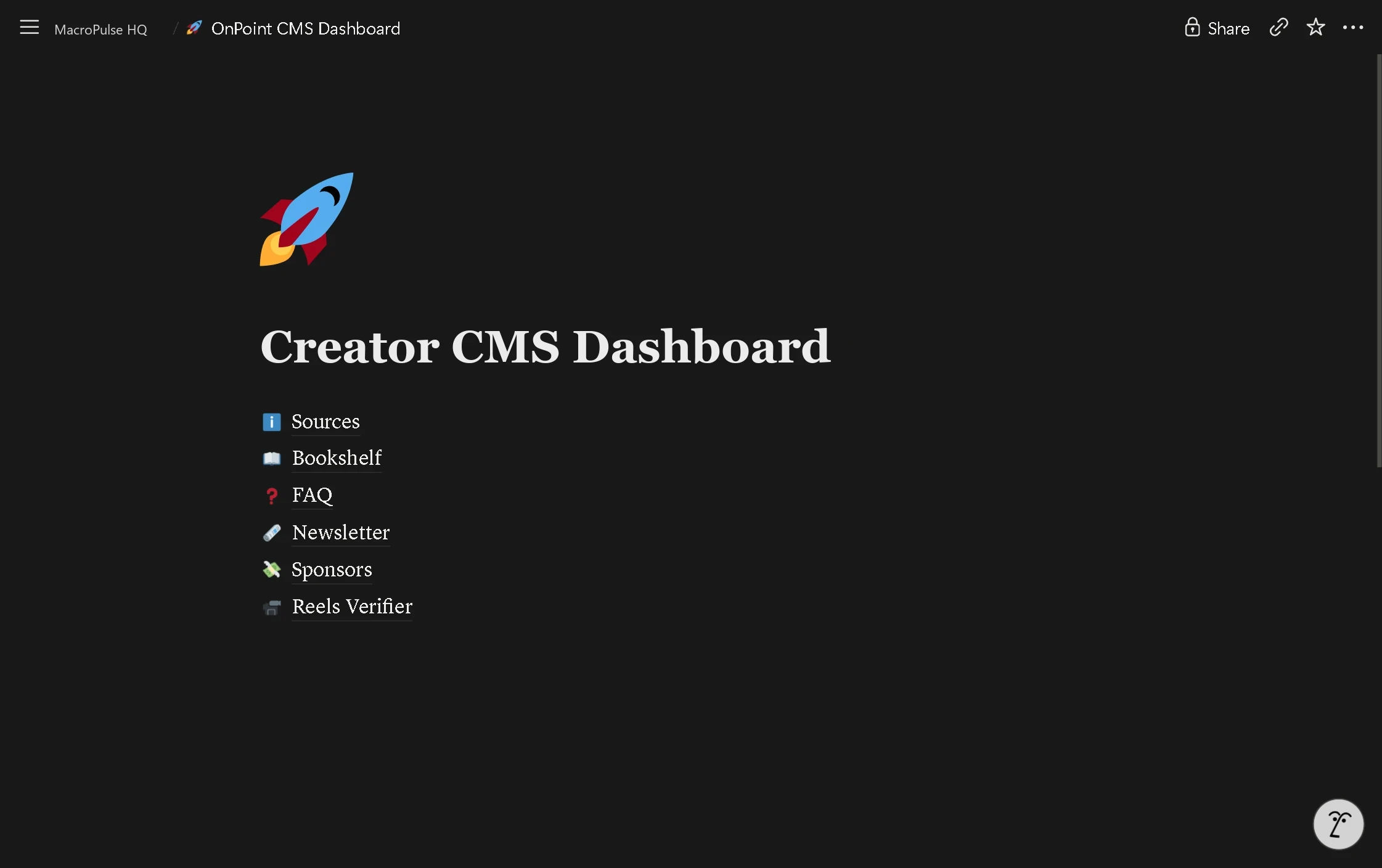
The creator authoring workflow is partitioned across 8 tightly-coupled relational databases within a unified Notion workspace:
| Database | Primary Key | Relations | Purpose |
|---|---|---|---|
| Sources | Slug (Text) | Reels, Claims | Primary regulatory filings, research reports, and verified citations. |
| Bookshelf | BookID (Text) | Sources | Curated library with custom CSS spine rendering, affiliate links, and book summaries. |
| FAQ | QuestionID (Text) | Sources | Educational FAQ system with SEBI-compliant non-advisory disclaimers. |
| Newsletter | IssueID (Number) | Sources, Sponsors | Published editorial newsletters distributed to subscribers via Beehiiv sync. |
| Sponsors | PartnerID (Text) | Newsletter | ASCI-compliant partner disclosures and campaign sponsorship logs. |
| Corrections | CorrectionID (Text) | Reels, Sources | Public transparent correction ledger demonstrating editorial integrity. |
| Claims | ClaimID (Text) | Sources, Reels | Atomic verifiable factual claims extracted from video scripts. |
| Reels | VideoID (Text) | Sources, Claims | Short-form video metadata, timestamped transcripts, and citation mappings. |
Relational Architecture & Workspaces
The headless content backend exposes a clean, mobile-friendly authoring workspace directly in Notion, consumed headlessly by Next.js 16 via ISR:
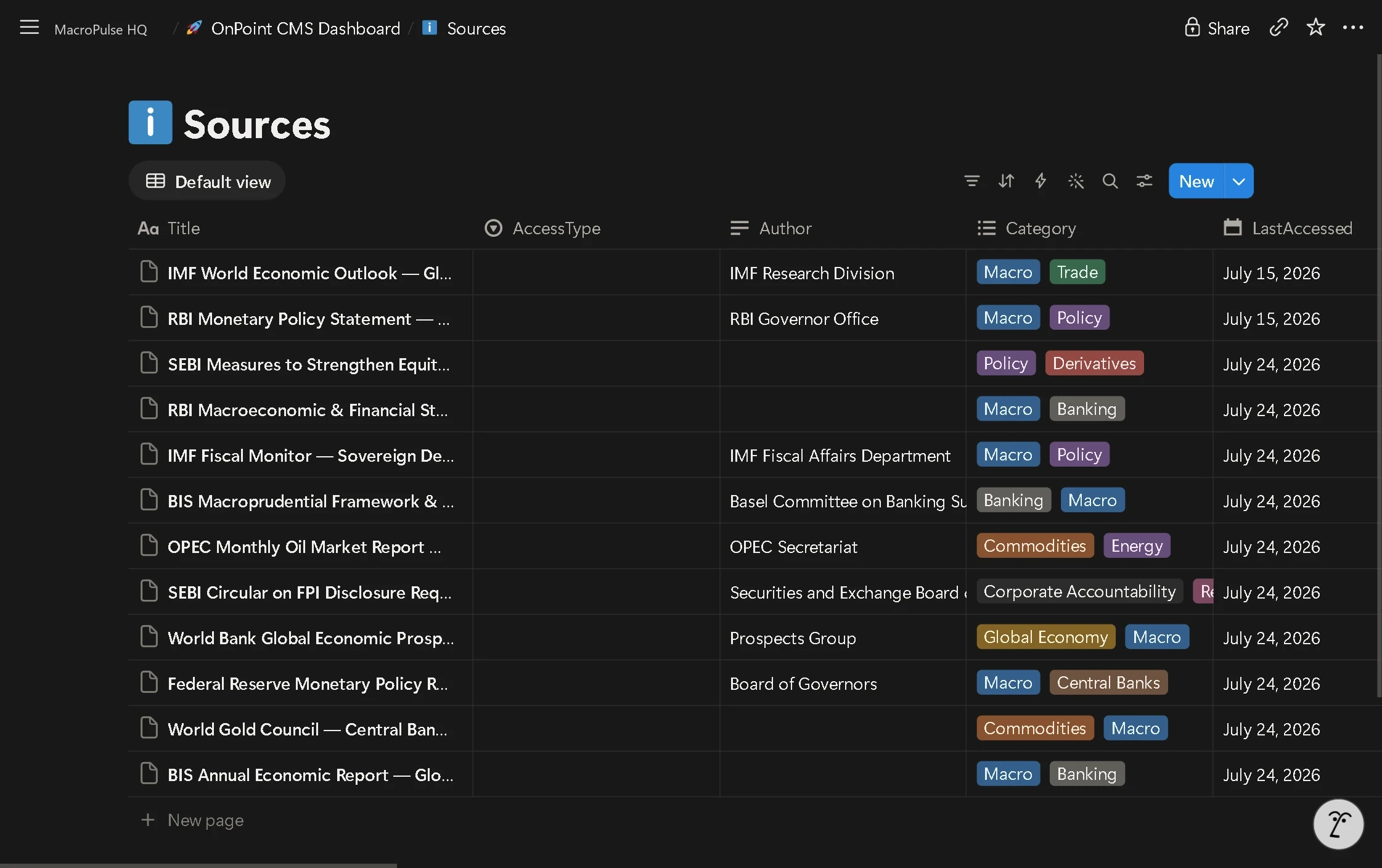 | 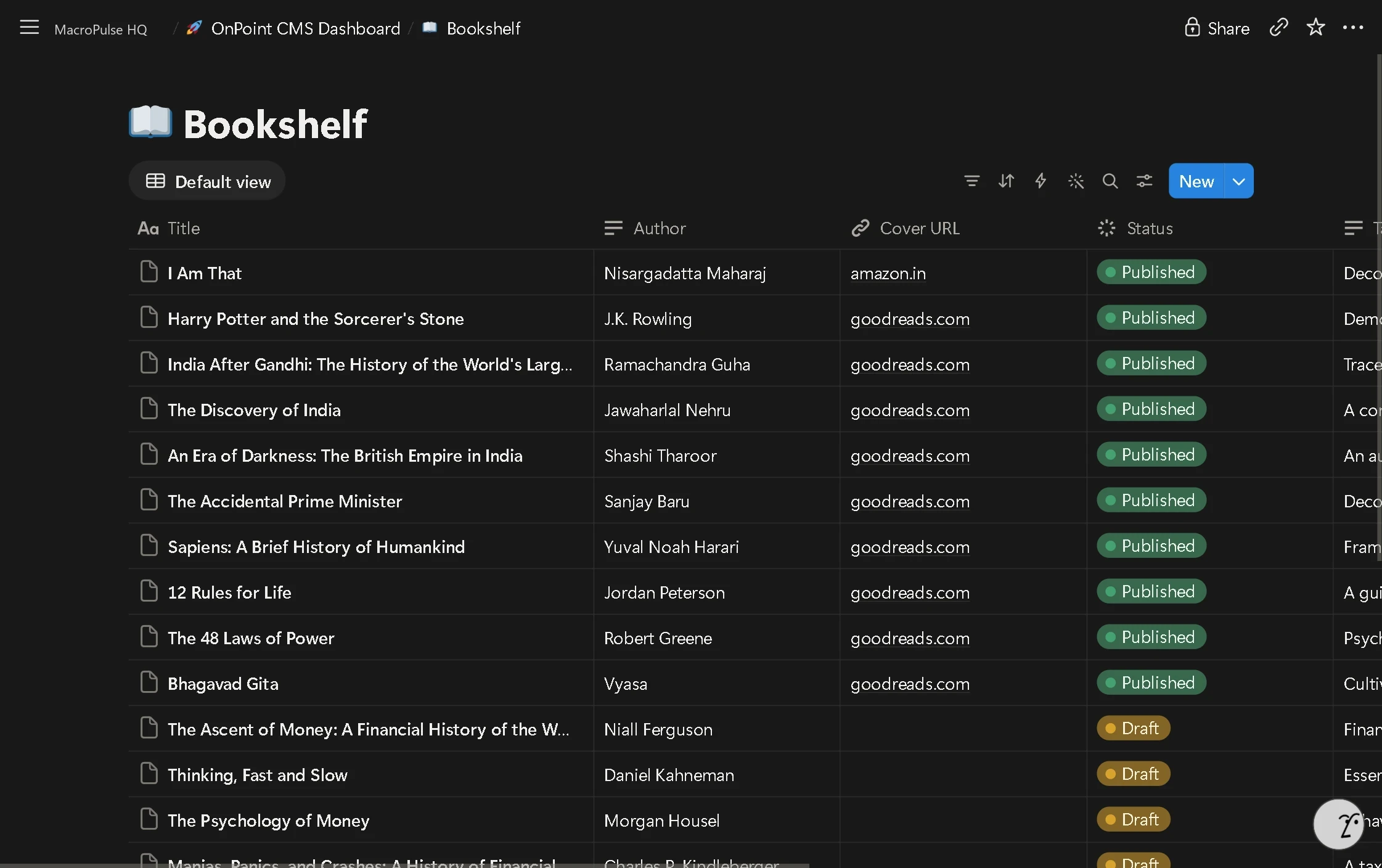 |
|---|---|
| Figure 2.2: Relational Sources Database with IMF, RBI, and SEBI regulatory tracking. | Figure 2.3: Relational Bookshelf Database with real-time Published/Draft lifecycle flags. |
3. The 11-Layer Core Notion Defense
To guarantee zero rate-limiting crashes (Notion's 3 req/s threshold) and prevent draft exposure, the following 11 defense layers are enforced:
Layer 1: Proactive Semaphore Throttling
- Integrates a custom async semaphore wrapping the
@notionhq/client. - Limits outgoing requests to 0.67 req/s (guaranteeing utilization remains below 22% of Notion's 3 req/s quota).
- Normalizes incoming query keys in middleware via
NextResponse.rewriteto prevent CDN cache-fragmentation attacks.
Layer 2: Reactive Jittered Exponential Backoff
- Traps HTTP 429, 502, 503, 504, and 529 responses.
- Implements AWS-style full-jitter backoff: $$\text{Sleep} = \text{random}(0, , \min(M, , B \cdot 2^{\text{attempt}}))$$
- Employs a dual-format header parser compatible with both Unix epoch timestamps and delta-second offsets in
Retry-After.
Layer 3: Degraded Emergency Bypass Snapshots
- Flag:
NOTION_BYPASS_ON_BUILD_FAILURE=true. - In the event of catastrophic third-party Notion downtime, builds automatically fail over to version-controlled JSON snapshots stored under
src/data/fallback/. - Every snapshot is strictly validated against the corresponding Zod schema before emission.
Layer 4: Content Integrity & Draft Leakage Guard
- Queries enforce
filter: { property: "Status", select: { equals: "Published" } }. - Post-fetch Zod parser validates that
isDraft !== true. - Automated regex audit verifies the absence of internal editorial notes or unreleased draft content.
Layer 5: Observability & ISR Freshness Probes
- Dedicated health check endpoint:
/api/health/isr-freshness. - Returns HTTP 200 with JSON telemetry detailing cache hit rates, database staleness timestamps, and fallback status.
- Triggers alerts if any cached route exceeds $2\times$ its expected TTL.
Layer 6: Content-Loss Prevention (Minimum Row Assertions)
- Guard assertions enforce minimum expected row counts per database:
Sources >= 5,Bookshelf >= 3,FAQ >= 2,Newsletter >= 2,Sponsors >= 2,Corrections >= 1.
- Prevents accidental deletion of entire datasets due to faulty Notion API filter queries.
Layer 7: Preview Deployment Environment Isolation
NOTION_API_KEYis isolated to the production deployment environment.- Branch previews and PR deploys compile exclusively against static fallback snapshots, preventing staging pipelines from exhausting production API quotas.
Layer 8: Compliance & Stale Snapshot Safeguards
- Fallback snapshots carry an immutable
snapshot_date. - Git pre-commit hooks warn if fallback data exceeds 90 days of age.
Layer 9: Automated AI Crawler Coherence
- Webhook notifications from Notion trigger automated revalidations of
/llms.txtand/sitemap.xml. - Guarantees that AI search engines (Perplexity, ChatGPT, Claude) always ingest fresh, synchronized content entity graphs.
Layer 10: Edge-Request Budget Optimization
- Middleware uses internal URL rewrites instead of HTTP 308 redirects to normalize tracking parameters.
- Reduces billable Edge Request counts by 50% during viral social media spikes.
Layer 11: Multi-Tier Cache Persistence
- Leverages Next.js
unstable_cachewith tagged cache invalidation (revalidateTag('notion')). - File-system backed caching survives serverless container restarts and server cold starts.
4. Edge Security & Compliance Directives
- SEBI Non-Advisory Compliance: Educational disclaimer components are embedded statically into the layout root, verified by automated DOM assertions during build time.
- ASCI Sponsorship Guardrails: Every commercial sponsor mentioned in newsletter issues dynamically pulls verified disclosure tags from the Sponsors relational database.
- DPDP Minimal Consent: Newsletter subscriber forms collect only email addresses with explicit opt-in checkboxes, backed by server-side Zod email sanitization.